S&DR200: Opening Spectacle event: All Change!
Dr. Erin Beeston recently joined the Manchester Histories team for the official launch of the S&DR200 Opening Spectacle, marking the 200th anniversary of Stockton and Darlington Railway (SDR) and shares her reflections on the event. Blog Post by Dr. Erin Beeston
All Change!
A trip to the launch of the S&DR200 Opening Spectacle.
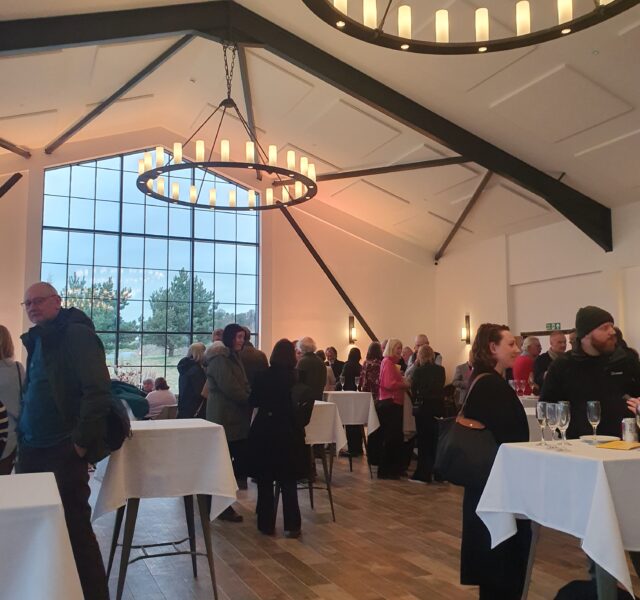
At the end of March, I had the pleasure of joining the ever-enthusiastic Manchester Histories team on a trip to the official launch of the S&DR200 Opening Spectacle, marking the 200th anniversary of Stockton and Darlington Railway (SDR). Why were we so enthused? The history of the SDR is bound with the Liverpool and Manchester Railway, which we will celebrate with Rocket: All Aboard in 2029/ 2030. George Stephenson’s technical developments through Locomotion No. 1 and the construction of the SDR to connect collieries in Stockton and Darlington enabled the later, more ambitious project between Liverpool and Manchester. The railways distinct institutional and regional histories have resulted in separate celebrations, but their connections have been long recognised. For example, during the SDR Centenary, a Railwayman’s Pageant – reportedly the idea of ‘a shunter from Edge Hill’ (The Manchester Guardian, 28 September 1925) – was celebrated with much aplomb at Belle Vue, including the crowning of the first ‘railway queen’.
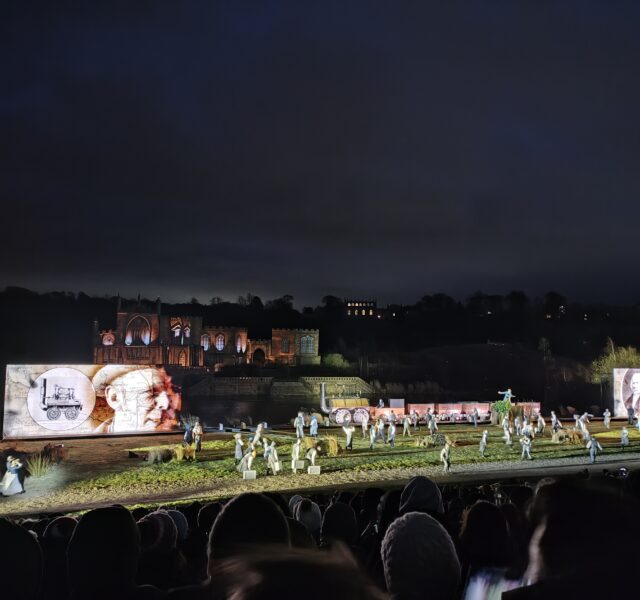
All Change! took place at the permanent location of Kynren in Bishop Auckland, where a pageant of British history is regularly held, making a grand setting for the performance. The Infant Hercules male voice choir opened the show as the sun set, cutting through the wind to bring us traditional songs from the area. Once the sun went down, a first-person narrative began with an elderly woman speaking about her experience as the first traveller on the SDR. A screen at each side of the stage flanked performers enacting the narrative, meanwhile a railway track ran behind the screens, so a full-sized replica of Locomotion No.1 could emerge from the projections.
Through using later nineteenth century reminiscences as the starting point, the story could shift (using split-flap displays to show the date) through time. This device allowed for a nonlinear narrative, a refreshing change from the usual progressive storytelling of the railway – which historically has been rife with imperial overtones and British exceptionalism (see suggested reading below). Flip-flopping through time perhaps sounds confusing, but the storytelling was seamless by returning to the narrator between scenes – as they explained what they witnessed after the SDR in the nineteenth century. A second narrator offered later developments and contextualised the first-person narrative throughout. Anthony Coulls, NRM’s senior rail transport and technology curator at York and Shildon, explained that they were consulted from on script and suggested using children they’d identified as the first passengers on the railway through archival research. These nuggets of social history informed the storytelling and ensured that it didn’t repeat the oft-told ‘great men’ story of the railways.
Another interesting storytelling device was the use of railway analogies to explain later developments in the history of technology, such as Ada Lovelace’s concept of computing – ‘a new type of engine’. Celebrations of Karen Harrison, the first woman train driver, and Asquith Xavier’s challenge to the colour bar on British Railways provided audiences a more holistic social history. The role of the railways in transporting troops and civilians in both world wars also made for particularly moving scenes.
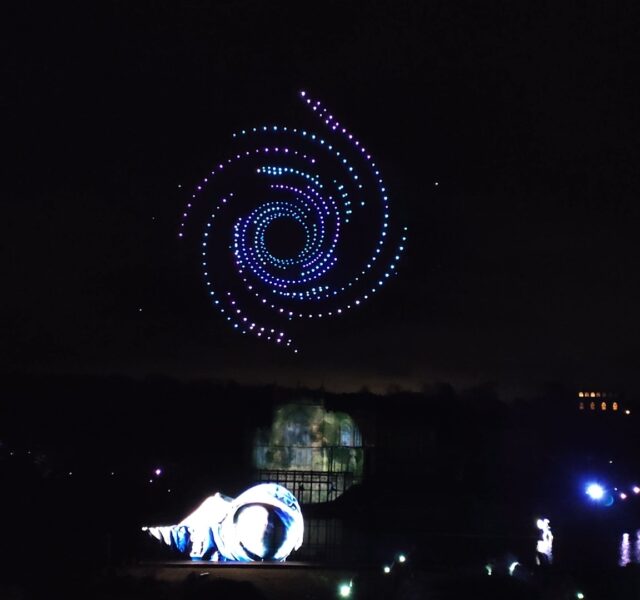
One scene that I won’t forget in a hurry was a witty portrayal of the Beeching Cuts through a Rock ‘n’ Roll dancing competition. This may sound strange, but with maps on the screens showing station locations as Doctor Beeching judged dancers to be taken off the dance floor – the breadth of railway closures was clear. The range of historical events presented across All Change was impressive, we even launched into Space, where drones were used to enhance the spectacle in the closing scenes. We certainly took home lots of inspiration, a few delightful souvenirs, and enthusiasm for 2030 with our slightly soggy selves back to Manchester.
If you’d like to find out more about past celebrations, Dr Sophie Vohra did extensive research on commemoration of the SDR for her doctoral thesis with the National Railway Museum and wrote this insightful article about the jubilee and centenary.
In the first chapter of my PhD thesis I looked at how narratives of the Liverpool and Manchester Railway developed, including work on the role of the LMR Centenary and its aggrandising historical pageant. You can read more about how the Liverpool Organisation developed the LMR Centenary for the city’s 1930 ‘civic week’ in ‘Victorian Monuments to Centenary Celebrations: The Liverpool and Manchester Railway and Liverpool’s Civic History’, Liverpool History Journal Vol. 21 (2022).
S&DR200 is a 9-month international festival taking place across County Durham and Tees Valley in 2025, to celebrate the 200th anniversary of the first journey on the Stockton and Darlington Railway (S&DR). Find out more HERE.